General News
29 December, 2025
Skydive scare
A SKYDIVER dangled below a jump aircraft after a reserve parachute became snagged on the tailplane during a jump run over Tully Airport, in an incident detailed in an Australian Transport Safety Bureau final report.

The Cessna Caravan took off from Tully on 20 September 2025 with a pilot and 17 parachutists on board. The group was planning a 16-way formation jump from 15,000 ft, filmed by a parachuting camera operator.
Once at the required altitude, the pilot slowed the aircraft to 85kts, extended 10° of flap and signalled the jump to begin.
While the first parachutist was climbing out of the roller door, the handle for their reserve parachute snagged on the wing flap, inadvertently deploying the chute.
The deployment dragged the parachutist backwards, causing their legs to strike the aircraft’s left horizontal stabiliser and substantially damage it. The parachute then wrapped around the stabiliser, leaving the parachutist suspended beneath the aircraft.
“The pilot recalled feeling the aircraft suddenly pitch up and observed the airspeed rapidly decreasing,” ATSB Chief Commissioner Angus Mitchell said.
“Initially unaware of what had occurred, the pilot believed the aircraft had stalled and pushed forward on the control column and applied some power in response. But upon being told there was a skydiver hung up on the tailplane, they reduced power again.”
The pilot reported significant control difficulties, with vibration through the controls and substantial forward pressure and right aileron input required to maintain straight-and-level flight.
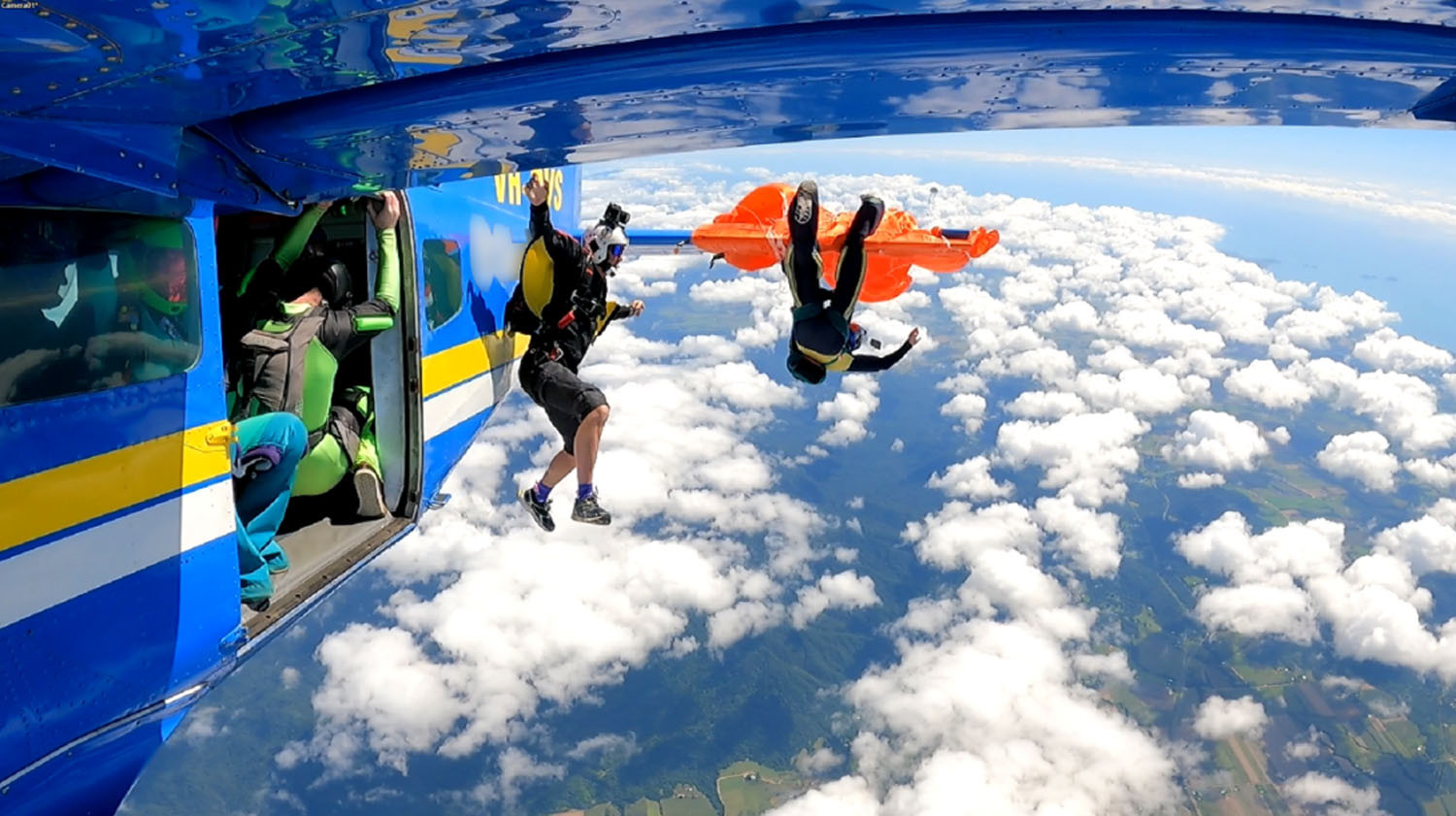
Meanwhile, 13 parachutists exited the aircraft, with two remaining in the doorway.
The snagged parachutist used a hook knife to cut 11 lines from the reserve parachute, allowing the remaining fabric to tear and freeing them from the aircraft.
Once in freefall, the parachutist deployed the main parachute, which fully inflated despite becoming tangled with the remaining reserve lines and canopy.
The skydiver landed safely and sustained minor injuries.
“With all parachutists out of the aircraft, the pilot assessed they had limited pitch control, given the substantially damaged tailplane, which still had a portion of the reserve parachute wrapped around it,” Mr Mitchell said.
The pilot maintained about 120kts during the descent and declared a ‘mayday’ to Brisbane Centre ATC, advising of minimal control input. Wearing an emergency parachute, the pilot prepared to bail out if control was lost, but at about 2500 ft, assessed that a landing was possible and landed safely at Tully.
Mr Mitchell said the incident highlighted the importance of parachutists being mindful of their handles and noted that carrying a hook knife, while not a regulatory requirement, could be lifesaving. The investigation also found that the pilot and operator did not ensure that the aircraft was loaded within its weight-and-balance envelope.
Read More: Tully